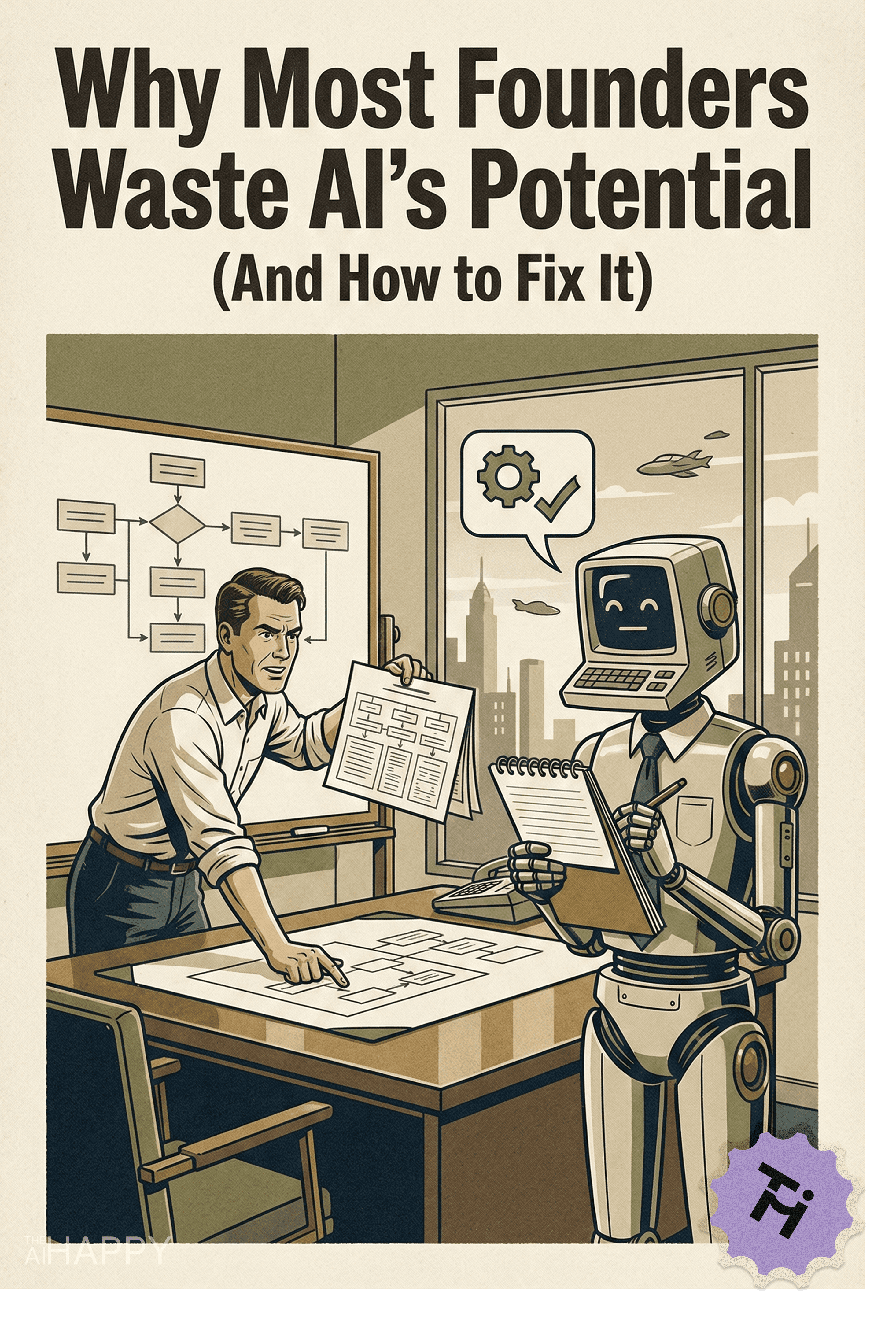
Why Most Founders Waste AI’s Potential (And How to Fix It)
Nic Cuthbert
22 Jan 2026
Most founders don’t struggle with access to AI.
They struggle with results.
They try ChatGPT, Copilot, or another tool.
They get something back.
It’s… fine.
But it doesn’t quite land.
It doesn’t sound like them.
It doesn’t save as much time as they expected.
So they tweak.
And tweak again.
And quietly decide AI is a bit overrated.
The problem isn’t the technology.
It’s how we use it.
TL;DR
Most founders treat AI like a search engine
This leads to generic, inconsistent, low-value outputs
The gap between “okay” and “useful” isn’t the tool, it’s the input
AI works best when you brief it like a team member, not query it like Google
Structure beats clever prompts every time
The Real Problem: AI Is Being Used Like Google
When most people start using AI, they do what feels natural.
They type a question.
They expect a good answer.
What they get instead feels like this:
Generic responses that sound robotic
Time wasted tweaking outputs
Inconsistent quality
AI that feels like a fancy search engine
That experience puts many founders off.
They assume the tool isn’t powerful enough.
Or that they need a more advanced model.
Or that AI “just isn’t there yet”.
In reality, they’re asking it to work in the wrong way.
The Shift That Changes Everything
There’s a simple mindset change that unlocks dramatically better results.
Stop prompting AI like a machine.
Start briefing it like a new team member.
That’s it.
When you think of AI as someone you’re delegating to, not querying, the quality of output improves almost immediately.
Just like with a human, clarity matters more than cleverness.
What Changes When You Get This Right
Founders who make this shift tend to see the same pattern of results:
Content created much faster
Responses shaped to their actual needs
More consistent quality across outputs
AI that starts to sound like their brand
Fewer revisions and far less frustration
Same tools.
Same technology.
Very different outcomes.
Why Structure Beats Clever Prompts
A lot of advice around AI focuses on “magic prompts”.
The truth is more boring, and more useful.
The secret isn’t clever prompts.
It’s structure.
Most effective AI usage follows a simple framework that people often skip.
A Simple Prompting Framework That Actually Works
Before you ask AI to do anything, cover these five elements:
1. Define the role
Who is the AI supposed to be acting as?
2. Specify the task
What exactly needs to be done?
3. Add context
Why does this matter? Who is it for?
4. Set constraints
What does “good” look like? What should be avoided?
5. Share examples
Show the standard you’re aiming for.
This mirrors how you’d brief a human.
And AI responds far better when treated the same way.
What This Looks Like in Practice
We’ve seen this approach make a tangible difference.
One founder reduced proposal writing time from hours to under an hour simply by briefing AI properly.
Another automated the bulk of their customer research analysis by structuring inputs instead of asking one-off questions.
No new tools.
No advanced models.
Just better inputs.
The Bigger Lesson for Founders
AI isn’t lacking capability.
Most businesses are lacking clarity.
As AI becomes more accessible, the advantage won’t come from having the tool.
It will come from knowing how to work with it deliberately.
Those who treat AI as a thinking partner, with structure and intent, will extract far more value than those who treat it like a search bar.
The Question Worth Asking
If AI is already available to you, the real question isn’t:
“What tool should I use?”
It’s:
What’s the one task you know AI should help with…
but still feels clunky today?
That’s usually where better inputs make all the difference.
